Found Inspiration in the Country Life of Families.
| American Gothic | |
|---|---|
 | |
| Artist | Grant Wood |
| Year | 1930 |
| Blazon | Oil on beaverboard |
| Dimensions | 78 cm × 65.3 cm (30+ 3⁄4 in ×25+ iii⁄4 in) |
| Location | Art Institute of Chicago |
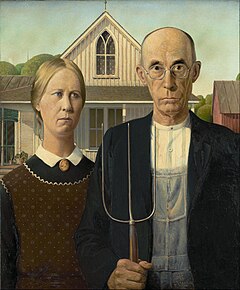
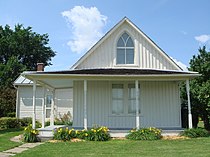
American Gothic is a 1930 painting by Grant Wood in the collection of the Art Institute of Chicago. Woods was inspired to paint what is now known as the American Gothic House in Eldon, Iowa, forth with "the kind of people [he] fancied should live in that house". It depicts a farmer continuing beside his girl – often mistakenly assumed to be his wife.[1] [2] The painting is named for the business firm's architectural style.
The figures were modeled by Wood's sister Nan Woods Graham and their dentist Dr. Byron McKeeby. The woman is dressed in a colonial print apron evoking 20th-century rural Americana while the human is adorned in overalls covered by a suit jacket and carries a pitchfork. The plants on the porch of the firm are mother in law's tongue and beefsteak begonia, which as well appear in Wood'due south 1929 portrait of his mother, Adult female with Plants.[3]
American Gothic is one of the most familiar images of 20th-century American art and has been widely parodied in American popular culture.[1] [4] From 2016 to 2017, the painting was displayed in Paris at the Musée de l'Orangerie and in London at the Regal Academy of Arts in its first showings outside the U.s.a..[five] [6] [7]
Creation [edit]

In Baronial 1930, Grant Woods, an American painter with European training, was driven around Eldon, Iowa, past a young local painter named John Abrupt. Looking for inspiration, he noticed the Dibble House, a minor white house built in the Carpenter Gothic architectural mode.[viii] Sharp'due south blood brother suggested in 1973 that it was on this drive that Wood first sketched the house on the back of an envelope. Wood's earliest biographer, Darrell Garwood, noted that Wood "thought it a form of borrowed pretentiousness, a structural absurdity, to put a Gothic-style window in such a flimsy frame house".[9]


At the time, Wood classified it as one of the "cardboardy frame houses on Iowa farms" and considered it "very paintable".[x] After obtaining permission from the house'due south owners, Selma Jones-Johnston and her family unit, Wood made a sketch the next 24-hour interval in oil paint on paperboard from the front yard. This sketch depicted a steeper roof and a longer window with a more pronounced ogive than on the actual house – features which somewhen adorned the concluding work.
Forest decided to paint the house along with, in his words, "the kind of people [he] fancied should live in that house".[1] He recruited his sister, Nan (1899–1990), to be the model for the daughter, dressing her in a colonial print apron mimicking 20th-century rural Americana. The model for the begetter was the Wood family'south dentist,[xi] Dr. Byron McKeeby (1867–1950) from Cedar Rapids, Iowa.[12] [13] Nan told people that her brother had envisioned the pair as father and daughter, not hubby and wife, which Wood himself confirmed in his letter to a Mrs. Nellie Sudduth in 1941: "The prim lady with him is his grown-up daughter."[1] [14]
Elements of the painting stress the vertical that is associated with Gothic compages. The upright, 3-pronged pitchfork is echoed in the stitching of the man's overalls and shirt, the Gothic pointed-arch window of the house nether the steeped roof, and the structure of the human'south face.[15] However, Wood did not add figures to his sketch until he returned to his studio in Cedar Rapids.[16] Moreover, he would non return to Eldon once again, although he did request a photograph of the dwelling house to complete his painting.[8]
Reception and interpretation [edit]
Forest entered the painting in a competition at the Art Institute of Chicago. 1 judge accounted it a "comic valentine", but a museum patron persuaded the jury to laurels the painting the statuary medal and a $300 cash prize.[17] The same patron also persuaded the Art Plant to purchase the painting, and information technology remains part of the Chicago museum's drove.[two] The image soon began to be reproduced in newspapers, kickoff by the Chicago Evening Post, and then in New York, Boston, Kansas Urban center, and Indianapolis. Notwithstanding, when the prototype finally appeared in the Cedar Rapids Gazette, in that location was a backlash. Iowans were furious at their depiction as "pinched, grim-faced, puritanical Bible-thumpers".[eighteen] Wood protested, saying that he had non painted a extravaganza of Iowans simply a depiction of his appreciation, stating "I had to go to French republic to capeesh Iowa."[11] In a 1941 alphabetic character, Wood said that, "In general, I take found, the people who resent the painting are those who feel that they themselves resemble the portrayal."[19]
Art critics who had favorable opinions about the painting, such as Gertrude Stein and Christopher Morley, similarly assumed the painting was meant to exist a satire of rural small-town life. Information technology was thus seen equally function of the trend toward increasingly critical depictions of rural America along the lines of, in literature, Sherwood Anderson's 1919 novel Winesburg, Ohio, Sinclair Lewis's 1920 Main Street, and Carl Van Vechten'due south 1924 The Tattooed Countess.[1]
However, with the deepening of the Bully Depression not as well long after the painting was fabricated, American Gothic came to be seen every bit a depiction of the steadfast American pioneer spirit. Woods assisted this interpretive transition by renouncing his bohemian youth in Paris and grouping himself with populist Midwestern painters such as John Steuart Curry and Thomas Hart Benton, who revolted confronting the dominance of East Coast art circles. Wood was quoted in this menstruum as stating, "All the good ideas I've ever had came to me while I was milking a cow."[1] American art historian Wanda M. Corn insists that Wood was not painting a mod couple, but rather 1 of the by, pointing to the fact that Woods directed the models to habiliment old-fashioned wear which he found inspiration for by consulting his family photo album. Forest even posed the figures in a style that resembled long-exposure photographs of Midwestern families that dated earlier World State of war I.[20]
In 2005, art historian Sue Taylor suggested that the figures in the portrait may actually represent Wood's parents. She claimed that due to Forest's male parent passing away when Woods was but ten years old, Wood did non develop a close human relationship with him but noted that he did spend the rest of his life very closely fastened to his mother. She theorizes that Wood may have developed an Oedipus complex and subconsciously expressed that in the painting. Taylor cites the lack of warmth between the 2 figures as well equally Wood's classification of them as "father and girl" was a way for Wood to remove whatever sexual connotation and so that Wood wouldn't have to confront his own fears and insecurities. Taylor also points out similarities betwixt other portraits of Wood's female parent and the woman in American Gothic, including the brooch that she wears. [21]
Art historian Tripp Evans interpreted it in 2010 equally an "sometime-fashioned mourning portrait ... Tellingly, the curtains hanging in the windows of the house, both upstairs and down, are pulled closed in the centre of the solar day, a mourning custom in Victorian America. The woman wears a black clothes beneath her frock, and glances away as if property dorsum tears. I imagines she is grieving for the homo beside her." Forest had been only 10 when his male parent died, and later he lived for a decade "above a garage reserved for hearses", and so death was probably on his mind.[22]
In 2019, culture writer Kelly Grovier described it equally a portrait of Pluto and Proserpina, the Roman gods of the underworld. He interprets the small world on the weather vane at the very top of the painting as representing the then-recent discovery of the dwarf planet Pluto, the pitchfork-wielding farmer as the guardian of the gates of hell, and points to the woman's cameo brooch, containing a classical representation of the mythological goddess, and the dangling strand of pilus by the adult female's right ear as representing the ravishing in the goddess'southward myth.[23]
Parodies and other references [edit]
The Depression-era agreement of the painting as depicting an authentically American scene prompted the beginning well-known parody, a 1942 photo past Gordon Parks of cleaning woman Ella Watson, shot in Washington, D.C.[1]
American Gothic is a often parodied image. It has been lampooned in Broadway shows such as The Music Man, movies such as The Rocky Horror Picture Show, and television shows such as Greenish Acres (in the final scene of the opening credits), The Dick Van Dyke Testify ("The Masterpiece" episode), and the SpongeBob SquarePants episode "FarmerBob". Information technology has also been parodied in marketing campaigns, pornography, and by couples who recreate the image photographically by facing a camera in the same fashion, i of them holding a pitchfork or other object in its place.[ane] [4] The painting famously appears in the opening titles of the tv set show Drastic Housewives (2004–2012).[24] The couple from the painting was too recreated in the HBO drama Oz during 1 of the bear witness's monologue segments in the episode 'A Town Without Pity' during the outset half of the evidence's quaternary flavor. The Dibble Business firm was not included owing to logistical and budget constraints.
Run into also [edit]
- Protestant work ethic
- Southern Gothic
References [edit]
- ^ a b c d due east f g h Fineman, Mia (June 8, 2005). "The Near Famous Subcontract Couple in the World: Why American Gothic nevertheless fascinates". Slate.
- ^ a b "About This Artwork: American Gothic". The Fine art Constitute of Chicago. Archived from the original on May 28, 2010. Retrieved June 20, 2010.
- ^ "The Painting". American Gothic Firm. Archived from the original on November 29, 2014. Retrieved January eight, 2015.
- ^ a b Güner, Fisun (February eight, 2017). "How American Gothic became an icon". BBC . Retrieved March 2, 2017.
- ^ Cumming, Laura (February v, 2017). "American Gothic: a country visit to U.k. for the first couple". The Guardian . Retrieved March two, 2017.
- ^ "American Painting in the 1930s: Musée de l'Orangerie". musee-orangerie.fr. Archived from the original on 26 Oct 2017. Retrieved ii March 2017.
- ^ Artwork 6565 Art Institute of Chicago
- ^ a b "American Gothic Firm Center". Wapello County Conservation Lath. Archived from the original on June 18, 2009. Retrieved July xiv, 2009.
- ^ Garwood, p. 119
- ^ Quoted in Hoving, p. 36
- ^ a b Semuels, Alana (April 30, 2012). "At Dwelling house in a Piece of History". Los Angeles Times . Retrieved Feb 25, 2013.
- ^ "Dr. Byron McKeeby's contribution to Grant Woods'due south 'American Gothic'"
- ^ "The models for American Gothic". Archived from the original on January 6, 2015. Retrieved January viii, 2015.
- ^ "Grant Woods's Letter Describing American Gothic". Campsilos.org. Retrieved April 12, 2010.
- ^ "Grant Forest'southward American Gothic". Smarthistory at Khan Academy. Retrieved December eighteen, 2012.
- ^ Quoted in Biel, p. 22
- ^ Biel, Steven (2005). American Gothic: A Life of America's Most Famous Painting . West. West. Norton & Visitor. p. 28. ISBN978-0-393-05912-0.
- ^ Andréa Fernandes. "mental_floss Web log » Iconic America: Grant Wood". Mentalfloss.com. Archived from the original on February 15, 2009. Retrieved Apr 12, 2010.
- ^ "Grant Woods's Letter Describing American Gothic". www.campsilos.org. Archived from the original on May 4, 2021. Retrieved June xxx, 2020.
- ^ Corn, Wanda One thousand.; Wood, Grant (1983). "The Birth of a National Icon: Grant Wood's "American Gothic"". Art Institute of Chicago Museum Studies. 10: 253–275. doi:x.2307/4104340. JSTOR 4104340.
- ^ Taylor, Sue (2005). "Grant Wood'south Family unit Album". American Art. nineteen (two): 48–67. doi:10.1086/444481. ISSN 1073-9300. JSTOR 10.1086/444481.
- ^ Deborah Solomon (October 28, 2010). "Gothic American". The New York Times.
- ^ "How Science and Tech Left an Imprint on 3 Iconic Paintings", Kelly Grovier, Wired, January 9, 2019. Excerpted from A New Style of Seeing: The History of Art in 57 Works ISBN 978-0500239636
- ^ The Daily Telegraph
Sources [edit]
- Garwood, Darrell (1944). Creative person in Iowa: A Life of Grant Wood. New York: Due west. W. Norton & Company. OCLC 518305.
- Hoving, Thomas (2005). American Gothic: The Biography of Grant Forest'southward American Masterpiece. New York: Chamberlain Bros. ISBN978-one-59609-148-1.
- Girod, André (2014). American Gothic: une mosaïque de personnalités américaines (in French). Paris: L'Harmattan. ISBN978-2-343-04037-0.
Further reading [edit]
- Howard, Beth G. (March eighteen, 2018). "Masterpiece Rental: My Life in the 'American Gothic' Business firm". The New York Times. ISSN 0362-4331. Retrieved April v, 2018. (contains image of outset Wood sketch of the house)
External links [edit]
| External video | |
|---|---|
 | |
 Smarthistory: Grant Wood's American Gothic Smarthistory: Grant Wood's American Gothic | |
| American Gothic House |
- Grant Wood and Frank Lloyd Wright Compared
- About the painting, on the Art Institute's site
- Slate article virtually American Gothic
- American Gothic, French
- American Gothic: A Life of America'southward Well-nigh Famous Painting
- Television Commercials (1950s-1960s) contains General Mills New Country Corn Flakes commercial
- American Gothic sculpture removed from Michigan Avenue
- American Gothic Parodies drove
- November xviii, 2002, National Public Radio Morn Edition report near American Gothic by Melissa Gray that includes an interview with Art Institute of Chicago curator Daniel Schulman.
- June 6, 1991, National Public Radio Morning Edition report on Iowa'south celebration of the centennial of Grant Wood'due south birth by Robin Feinsmith. Several portions of the study focus on American Gothic.
- February thirteen, 1976, National Public Radio All Things Considered Cary Frumpkin interview with James Dennis, author of Grant Wood: A Study in American Art and Civilization. The interview contains a give-and-take well-nigh American Gothic.
Source: https://en.wikipedia.org/wiki/American_Gothic
0 Response to "Found Inspiration in the Country Life of Families."
Postar um comentário